
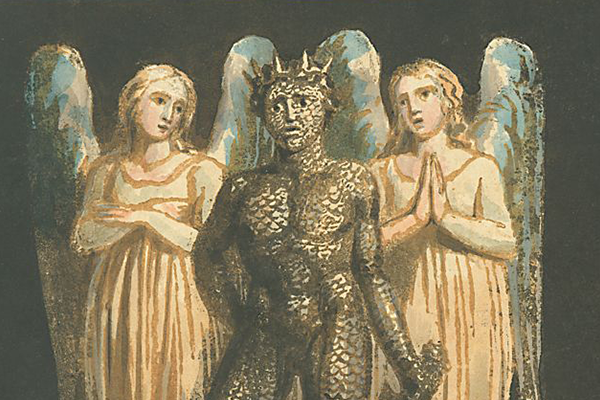
Henry W. and Albert A. Berg Collection of English and American Literature, The New York Public Library. (1794). Now comes the night….
You might be tempted to click away from the topic of Demons and Angels. My attitudes and beliefs were challenged while writing about it. There is rhetoric in current political conversations where human beings are accused of being Demons. Some behaviors are so extreme I’ve wondered if a human being can descend to being a Demon or ascend to being an Angel. I hope you will discover what I’ve learned is useful to you. I used my research assistant ClaudeAI heavily in the first section. Even if I had access to a university library, doing this level of research would have taken me longer than seven minutes. I always ask for references and check them.
I believe in Angels; I celebrate the energy we call the Archangel Michael. I’ve written two blogs on the Archangel Michael. (All links in references). But when I ask myself if I believe in Demons, I find myself hedging. I believe human beings perform demonic behaviors and other human beings are loved for behaviors that cause family and friends to say “H/she’s an angel.” But…
Describing Demons and Angels
Because it is worth doing, please take a minute and quickly scribe or draw what images come to mind for “angel” and “demon.” I’ll ask you to add to a description later and you may end up with a graphic or paragraph you can use for your own reflections later.
I drew two cartoonish images, adding wings to one stick figure and a pointed tail and ears and hooved feet to the other. After scrolling through what feels like a thousand images looking for a lead photo for this blog, I can say both demons and angels are pictured in human bodies with repeated attributes:
- the common image for an angel is a tall being of light with fluffy white wings dressed in a flowing white robe. Usually blond.
- devils are thin, often have horns and a tail, and are colored red.
If we were together as a group we’d share and chart our descriptions. For collective information I asked my assistant ClaudeAI to research the presence, description and function of angels and devils in major world faiths. Seven minutes later it produced a dozen pages of annotated information. I’m including the AI summaries here. If you are familiar with Judeo, Christian and Islamic definitions, just skim or skip. Knowledge from the Native Americas follows.
Angels
The following is from a ClaudeAI summary on Angels.
The similarities are striking:
- Multiple wings appear in Islamic (2-600 wings), Christian/Jewish (4-6 wings) descriptions
- Multiple faces/heads appear in biblical cherubim (4 faces) and Hindu rakshasas (Ravana’s 10 heads)
- Eyes covering the body appear in biblical cherubim and some Buddhist wrathful deities
- Shape-shifting abilities are shared by Hindu rakshasas and jinn in Islam
- Light/fire association connects Islamic angels (created from light), seraphim (burning ones), and some Buddhist manifestations
The key difference is theological: Islamic and Judeo-Christian angels are purely spiritual servants of God, while Hindu and Buddhist beings exist on a moral spectrum with the potential for both good and evil, … in cycles of rebirth.
I asked the general AI overview what Archangel Michael’s name meant.
The Archangel Michael’s name is derived from the Hebrew Mikha’el and means “Who is like God?” It is interpreted as a rhetorical, humble, and powerful question emphasizing that no one is equal to or higher than God. The name is often viewed as a battle cry against evil. It is sometimes interpreted as “There is none like God,” a definite rebuke to Lucifer. Michael is honored as a warrior, the chief of the angels, and the defender of God’s people in Christianity, Judaism, and Islam.
Fear not
 When angels show up their opening sentence is often “Be Not Afraid” or “Fear not.” A knowledgeable and respected friend told me she wanted to see an angel so badly she prayed about it for a long time. Kneeling by her bed one day she prayed and looked up to see two sandaled feet descending. Terrified, she said “Never mind.” This could be a joke, but I share it because it’s the only sighting by a person I know.
Robert Bly comments in his book Iron John that “Every angel is dangerous,” Rilke says, “so some fear is appropriate,” in a section called “The Wild Man and His Qualities” in the chapter “The Wound by the King’s Men.” The quote comes from the poet Rainer Maria Rilke’s Duino Elegies, “The Second Elegy.”
Every Angel is terror. And yet,
ah, knowing you, I invoke you, almost deadly
birds of the soul. Where are the days of Tobias,
when one of the most radiant of you stood at the simple threshold,
disguised somewhat for the journey and already no longer awesome
(Like a youth, to the youth looking out curiously).
Let the Archangel now, the dangerous one, from behind the stars,
take a single step down and toward us: our own heart,
beating on high would beat us down. What are you?
Robert’s quote again including his last point: “Every angel is dangerous” Rilke says, so some fear is appropriate. But knowing nothing is not appropriate.”
Demons
In the Christian, Jewish. and Muslim traditions demons are fallen angels. One angel, Lucifer, is radiant, wise, and beautiful beyond any other angel. Lucifer means “light.” But he is consumed by pride in his own glory, deciding to set his throne above God’s.
ClaudeAI offers these interesting variations:
Islam emphasizes disobedience rooted in arrogance, a reprieve rather than a battle, and a tempter who operates within divinely permitted limits until Judgment Day.
Jewish tradition is more restrained, with no fully developed Lucifer mythology in the canonical texts, though rich speculation existed in the intertestamental literature. All three traditions agree on the essential root: a supremely gifted spiritual being was destroyed by pride.
The Christian account emphasizes a dramatic war, a decisive defeat, and a permanent transformation of Lucifer into Satan — a being of cosmic evil. He draws a third of the angelic host into his rebellion and wages war against God. The Archangel Michael generals the forces for God in this war.
ClaudeAI’s (I think amazing) summary of this moment.
When Michael’s forces win the war Lucifer “is hurled from heaven down to earth; the shining one, the morning star, becomes Satan, the adversary. The fall doesn’t just change his location but his nature: beauty curdles into malice, wisdom twists into cunning, and he becomes God’s most committed enemy, turning his ambitions toward the corruption of humanity.”
These views, characters and stories change as we move into other cultures.
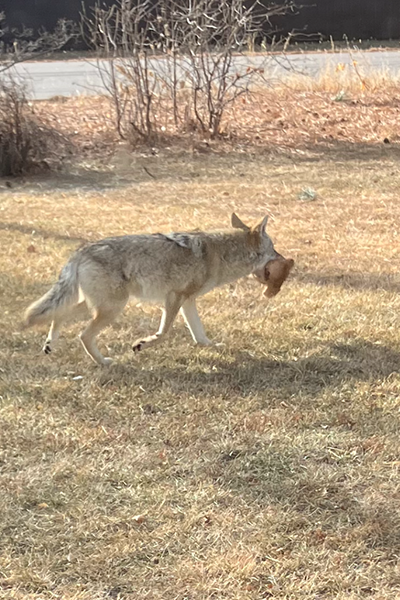
Red in Tooth and Claw – Coyote in the Neighborhood by D. Malcom Wells
Permeable Boundaries in Native Northern, Central and Southern Americas
I then asked Claude AI about North and South American Native peoples for similar or comparative spiritual figures.
Native American traditions generally don’t have “angels” and “demons” in the dualistic sense found in Abrahamic religions. Instead, there are spirit beings that exist on a spectrum—they can be helpful, trickster-like, dangerous, or contextually both beneficial and harmful.
These beings typically appear in forms connected to nature:
- Animal forms (bears, wolves, birds, snakes)
- Hybrid forms (part human, part animal)
- Elemental manifestations (wind, lightning, water)
- Sometimes humanoid but with distinctive features
Both Central and South American traditions viewed spiritual power as contextual rather than absolutely good or evil. The transformation between human and spirit forms represented a permeable boundary rather than a curse or divine punishment, and emphasizes the interconnection between all aspects of existence—human, animal, and spiritual.
Group and individual rituals aid the management of these permeable boundaries. Tribal shamans are skilled in ritual practices and guide their communities.
In northern Europe the ancient cross-quarter celebrations between the solar markers of Equinox and Solstice are also ancient practices. Samhain All Hallows knowledge comes forward as Halloween (with lots of devil and angel costumes). The All Souls and All Saints celebrations follow.
So… ideas of angel and demon beings are found worldwide with very different cultural expressions. What are all these cultures exploring over thousands of years? Archetypes manifested in so many different cultures indicate a recognition of real energies.
But do I, do you, believe in them as demons and angels?
Believing in Demons
In C.S. Lewis’ The Screwtape Letters, a senior demon coaches a novice demon nephew on how to tempt the person assigned to it. The book begins with a letter addressed to J.R.R. Tolkien on July 5, 1941. Lewis says:
There are two equal and opposite errors into which our race can fall about devils. One is to disbelieve in their existence. The other is to believe, and to feel an excessive and unhealthy interest in them. They are equally pleased by both errors …
Readers are advised to remember that the devil is a liar…
In the letters Devil coach Screwtape often points out to novice devil Wormwood how easy it is to tempt human beings because our culture doesn’t believe in them or reduces them to cartoons.
The book is written and published in the middle of WWII, the war against the Nazi regime that was sacrificing millions of people whose skin was not “white” or another unacceptable beingness (faith, gender, profession, political affiliation, …). Being unacceptable included being opposed openly to the Nazis.
Lewis’ England suffered the German Blitz’s nightly bombing raids on the industrial cities of London, Liverpool, Plymouth, Coventry. Lewis had served in WWI at age 19, was wounded, and suffered what we call PTSD (Post-Traumatic Stress Disorder). In WWII he had a local defense role and also housed refugee children from London in his home, the Kilns, in Oxford, England.
In the 1961 edition (two years before Lewis dies) he reminds us that the devil is an angel. He regretted not writing a mirror book of angels. Such a book perhaps would be titled Archangel Michael’s Advice to a Guardian Angel.
Worldwide also the polarity between Angel and Demon divides moral behaviors.
Demonic and Angelic Behaviors
If I ask you what word is the opposite of Evil what word do you choose? _________? Write it or them down please, maybe under or around the images or adding to descriptions you made earlier.
Here is how Google AI responded to this question:
In essence, while “good” is the general opposite, virtuous, righteous, or benevolent better capture the moral counterbalance to profound evil. Describing profound moral positivity goes beyond just being “not bad”.
Evil implies deep malice or depravity, so its opposite needs words reflecting high moral character, like being virtuous or benevolent, rather than just “good”, “Evil” signifies deep moral corruption, requiring a stronger antonym like “virtuous” or “benevolent” to match its intensity.
- Goodness: Implies kindness, empathy, and well-being.
- Virtue: High moral excellence; a quality of being virtuous.
- Righteousness: Morally right or justifiable; adhering to divine or moral law.
- Benevolence: Kindness and generosity; a desire to do good.
Choosing Words
I am very tired of cultural Righteousness so I immediately strike that choice. Goodness and Benevolence are behavioral results. Virtue points me to the Seven Deadly Sins and Seven Quickening Virtues that add Parson lists in Chaucer’s Canterbury Tales.
Virtue
Humility
Chastity
Mercy
Abstinence
Diligence
Kindness
Patience
Deadly Sin
Pride
Lust
Greed
Gluttony
Sloth
Envy
Wrath
I’ve charted the centuries of human wisdom gathered in the Parson’s list in my blog Chaucer and Free Will (link below).
The immigrant Puritans in early North American colonies strived to behaviorally achieve the extreme right in all seven. It did not turn them into angels.
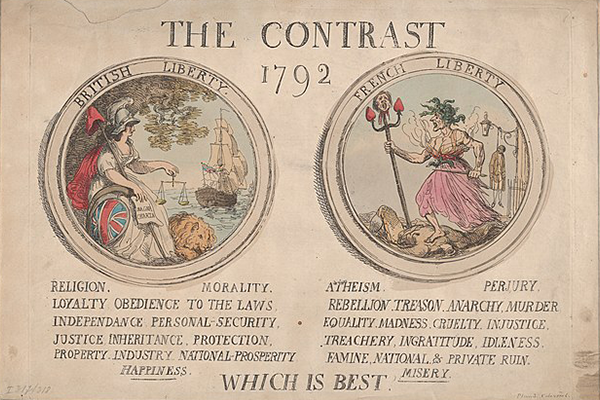
The Contrast 1792. British Liberty. French liberty. Which is best? (BM J,4.50)
The Demon Exchange: What Are You Willing To Trade Virtue For?
Demons in Grimms and other western tradition stories often appear as human beings and are dressed in clothes matching what the person being tempted is wearing. (“See, we’re the same cloth.”) The demon offers a deal. There will be a trick.
Beelzebub is one name our ancestor gave to the Devil. The “stage” area, often an inn yard, often had an area called a Hell’s Mouth. Our family performed for fifty years an evolving version of the ancient mummer’s play St. George and the Dragon. There’s more about this at my blog St. George and the Nightmare Knight. The one part no one ever wanted changed was Beelzebub, who comes in at the very end to carry the Knightmare Knight to hell.
In come I, Old Beelzebub,
And over my shoulder I carry a club.
In my other hand my frying pan
Don’t you think I’m a jolly old man?
If you don’t believe the words I say,
Step in little Devil-Doubt and clear the way.
His speech demonstrates how our ancestors knew evil could be identified by confused images and language.
Well, I was coming up a long short straight crooked lane, And I met a bark and he dogged me. So, I went to a stick and cut a bush And gave him a rump on the thump. Then I went along a standing still Through a land where the houses were thatched with pancakes, Until I came to a big little low broad tall narrow house. I went up and knocked at the old woman and a door came out. She asked me if I would eat a cup of cider And drink a bit of bread and cheese, And I said, “No thanks, yes, if you please.”
Then I picked up my frying pan and went my way and here I am
But soon I’ll be a-turning a spit, Over a fire that’s long been lighted;
Waiting in my deep, dark pit For this Knightmare so benighted.
Up, you liar! Time for the fire!
In Grimms Brothers Tale #31 a miller trades what’s behind the mill for wealth, thinking it’s the apple tree, but it is his daughter. The apple tree points to Eden’s tree of the Knowledge of Good and Evil and the devil’s temptation of Eve. In my blog, “To be as Clean as We Can” we learn how this savvy girl uses water to protect herself against the devil. The father sacrifices her (chops off her hands) in exchange for riches. Now wealthy, he promises to take care of her. She refuses to live with her betrayer and departs on her heroine’s journey.
Later in the story an angel (dressed in white) helps her into a King’s pear orchard. She eats a pear, which is against the King’s orders. The good king’s judgement is for Mercy. In this very complex story the devil is not done with this woman or the king. The interesting character of the King’s mother throughout demonstrates specific behaviors of how to straddle a moral divide and find a middle way.
My January 6th Epiphany blog this year explores King Midas’ deadly Sin of Greed and Nathanial Hawthorn’s attempt to add the opposing Virtue of Mercy to the ancient story. The “devil” in this story is the insatiable need to accumulate wealth. We are often offered individually and collectively the choice between Greed and Mercy. It is the choice the entire world is making right now. May we choose Mercy.
Mercy is not leniency. Mercy is God refusing to let sin have the last word.
-Nick Pijoan, Lawyer and Franciscan Brother
Being a Counterbalance to Profound Evil
It is possible as we diminished the power of both Demon and Angel, we diminished Evil and Virtue, made them bland, unimportant to choices we make in our lives. Robert Bly comments “We plan to meet God’s enemies with a little humor and a fine for non-compliance.” This comment is in Iron John in the section The Eternal or Sacred Warrior, in the chapter “To Bring the Interior Warrior Back to Life.”
I like the idea of each of us being a Sacred Warrior, sharpening our sword of reason and spear of truth, using our free will to defend compassion and mercy.
The war is first fought in our heart and mind. Imagine a novice devil whispering in one ear and a guardian angel in the other. “Despair. There’s no hope,” whispers the one. The other whispers Martin Luther King, Jr.’s advice: “Keep your eye on the prize.”
We have wisdom from our ancestors on how to navigate these inner terrains.
- Faced with profound powers dedicated to greed? Choose acts of mercy.
- Exhausted, overwhelmed, frightened? Refuse the temptation to focus on evil. Stop scrolling. Take a walk or a nap.
- Feeling alone? Choose community over isolation. Individuals make choices and join groups that constellate as a force for good or evil. Find people serving the Virtues and put yourself to work.
I watch for Angels Working signs in construction areas. Humor is essential and court judgements underpin justice. People everywhere are feeding the hungry. New coalitions devoted to right action are forming. We know it’s going to take each of us to counterbalance the profound evils of our time.
Equinox
The wisdom of Equinox is in staying in balance when polarities are pulling us apart. Our daily series of individual choices tilt the balance, within and without us. When feeling under attack, let’s slow down and open time. Let’s embrace that one step needs another to achieve balance. Let’s check our compass for the true north orientation of Love. Let’s remember that even at the last moment of life redemption is possible.
I’m writing on the porch as the rising sun turns low clouds gold, and early birds are messaging each other. Nothing moves other than my fingers on the keyboard. Equinox rises, when the earth balances in a yearly journey around our sun. We experience this fulcrum twice a year. The rest of the time we are moving towards more darkness or light.
Glancing up I see two large white birds flying south towards the sun, the same even rhythm to their long wing strokes. They are orientating towards light with a visible steadiness of spirit.
Whether I believe or not, consciously choose or not,
We are all held, with the universe, in the Creator’s love.
When attacked/beset/tempted/attracted to evil may I
Wake up and use my free will to embrace virtue.
References
My blog on Tale #31 “To be as Clean as We Can”
C.S. Lewis The Screwtape Letters
Fall Equinox and Archangel Michael’s Harvest of Souls
Servants of the Archangel Michael


Leave A Comment