
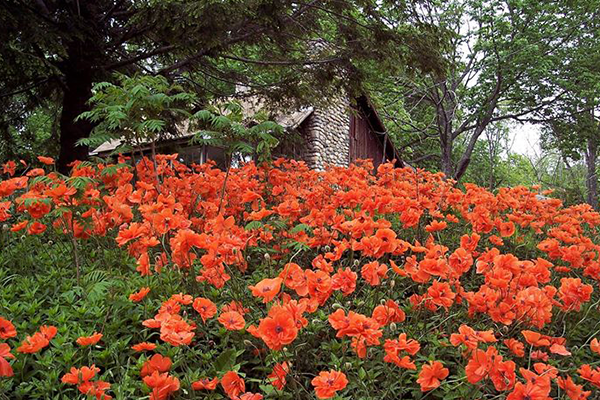
Poppies at Innisfree, Great Mother Conference
When Robert Bly’s Great Mother Conference gathered in Maine each year my husband and I would stop on the way and stand in this field of poppies. The conference was founded in 1975, not a whim but an offering to the feminine. I’ve recently been circling around the phrase “Cakes for the Queen of Heaven,” wondering about Offerings. This blog includes historic information about offerings and ancient/modern recipes for offerings. I’ve written it as a tapestry woven from several threads, rather than a linear progression of thoughts to a conclusion.
But first, some definitions.
Warp Threads on the Tapestry’s Loom
The word Offerings is both verb and noun.
As a verb: the action of making an offer, usually asking for an exchange.
-
- He offered $10,000 for the car and she accepted it.
- The corporation made an offer to incorporate the competitive company.
- Outside of all the formal negotiation they were offered personal millions.
- I’m going to offer my book to the publishing company.
As a noun: what is being offered.
-
- Isaac was raised to be an offering from Abraham to God but a ram became the offering instead.
- Flowers accompanied the offer.
- Her monthly Altar Guild thanksgiving offering to God was preparing the communion bread and wine.
- A small piece of turquoise was the right offering to the Irish fairies.
Commonly a life-giving substance is used as an offering, such as all kinds of animals, vegetables, fruits, cheeses. Also included are milk, honey, vegetable and animal oils, beer, wine, and water. Money is a substitute being offered rather than being spent for some other purpose.
Astronauts Circle the Moon
In the days of writing this blog we witnessed human beings circle our moon. To weave this part of the tapestry thread the loom with silver and black threads.
In 1969 I pulled my son and his buddy Scott out of bed to watch the first moon launch, wrapping them in blankets on the floor in front of the black and white TV in the living room. Nary a woman or person of color in sight and I didn’t think about why not. The first rocket was named Apollo, for the Greek god of the sun.
Astronaut Frank Borman made a prayer offering as he circled the moon in Apollo 8:
Give us, O God, the vision which can see Thy love in the world in spite of human failure. Give us the faith to trust Thy goodness in spite of our ignorance and weakness. Give us the knowledge that we may continue to pray with understanding hearts. And show us what each one of us can do to set forward the coming of the day of universal peace
The 2026 rocket is in the Artemis series, the Greek Goddess of the moon, a Queen of Heaven.
This time the NASA Launch Director was Charlie Blackwell-Thompson, a red headed woman wearing a Luna green suit, who paced a row of computers. The woman astronaut, Christina Koch, lived and worked on the International Space Station for most of 2019 in Expeditions 59, 60, and 61. I can’t find the name of the woman in charge of part of splashdown. The support teams were men, women, and a variety of races.
Pilot Victor Glover requested all of us on earth to offer prayers during the astronauts’ silence while on the far side of the moon.
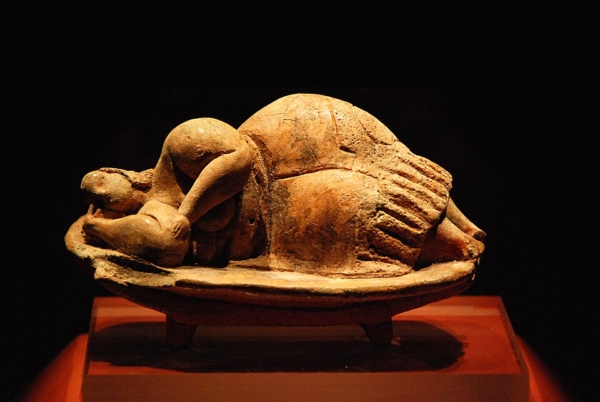
This clay figure of a reclining lady was found in one of the pits of the Hypogeum in Hal Saflieni in Malta. It has traces of red ochre paint and is thought to represent a “mother goddess”. Temple Period, 4000 – 2500 BC.
Who Are the Queens of Heaven
I traveled to Malta when I began studying Sacred Geometry with Dominique Susani several decades ago. We walked in temples that towered above our heads, mazes of complexity. We studied their underlying energy and structure. They were constructed between 3600 to 2500 BCE. They are older than Egypt’s pyramids.
- Ġgantija Phase (3600–3200 BCE): The earliest and largest structures, including Ġgantija (Gozo), were built during this time.
- Saflieni Phase (3300–3000 BCE): Construction of complex underground structures, such as the Ħal-Saflieni Hypogeum.
- Tarxien Phase (3000–2500 BCE): The height of temple building, including the ornate Tarxien temples and the Upper/Lower Mnajdra sites.
Non-cake offerings were often clay figurines of the goddess, often lying on her side, and apparently colored red.
Due to our teacher getting us on an entry list several months ahead of our visit we were able to go into the Hypogeum. I walked down to the bottom by the alcoves whose purpose is argued about. The alcoves felt to me to be places for human beings to lie down and dream or otherwise have visions. At the bottom I looked up and, following a compulsion to sing, sounded several notes. My voice filled the space, shocking the guards and visitors who stood frozen in place as the sound amplified. There is a recording titled Returning by Jennifer Berezin which you can hear by googling it. The Hypogeum’s threads in our tapestry are the blue of the Mediterranean on a sunny day, and the red ochre of this Queen of Heaven
A List of Queens of Heaven
These notes are provided by my research assistant Claude AI with sources. Each one is a thread of our tapestry.
The title “Queen of Heaven” was given to several ancient sky goddesses worshipped throughout the ancient Mediterranean and Near East. Goddesses known to have borne this title include Inanna, Anat, Isis, Nut, Astarte, and possibly Asherah. In Greco-Roman times, Hera and Juno bore this title. The Norse goddess Frigg has also been associated with it. Wikipedia
Inanna / Ishtar (Sumer / Akkad, from c. 3500 BCE): Inanna is the Sumerian goddess of love and war; her very name is commonly derived from Nin-anna, meaning “Lady of Heaven” in Sumerian. Although the title was given to many goddesses, Inanna is the one to whom it is given the most frequently. In Akkad to the north, she was worshipped as Ishtar. WikipediaHandWiki
Astarte (Phoenician / Canaanite): Astarte was connected with fertility, sexuality, and war. Her symbols were the lion, the horse, the sphinx, the dove, and a star within a circle indicating the planet Venus. She was accepted by the Greeks under the name Aphrodite. Wikipedia
Isis (Egyptian): Isis was venerated first in Egypt. According to Herodotus, Isis was the only goddess worshipped by all Egyptians alike. It was after the conquest of Egypt by Alexander the Great and the Hellenization initiated by Ptolemy I that she eventually became known as “Queen of Heaven.” In the second-century novel The Golden Ass by Apuleius, the goddess responds to prayer by declaring: “I am she that is the natural mother of all things, mistress and governess of all the elements… Queen of Heaven… and the Egyptians call me Queen Isis.” Wikipedia
Asherah (Canaanite / Hebrew): Asherah may be related to the Bronze Age goddess Athirat, queen of the Ugaritic pantheon. Most biblical scholars tend to regard Asherah, Anat, and Astarte as effectively the same figure under the title “Queen of Heaven.” Bible Odyssey
Hera / Juno (Greek / Roman): The queen of the Olympians bore the title by virtue of her position as consort of Zeus / Jupiter, king of the gods.
Mary (Christian): In modern times, the title “Queen of Heaven” is still used by contemporary pagans to refer to the Great Goddess, while Catholics, Orthodox, and some Anglican Christians apply the ancient title to Mary, the mother of Jesus. Ascension Glossary
Cakes for the Queen of Heaven as Ishtar/Inanna:
An ancient Hymn to Ishtar records: “Oh Ishtar, merciful goddess, I have come to visit you. I have prepared for you an offering, pure milk, a pure cake baked in ashes (kamanu tumri)… hear me and act favorably towards me.” The cake — an unleavened ash cake made from fine flour — was baked on the go, in haste, and the purity of the gift reflected the worshipper’s intention to be heard and blessed.
Recipe 1 The earliest cakes were flour and water, combined into a thick enough batter to create round patties stamped with the rounded goddess figure.
In the Hebrew bible Jeremiah 7:18 reads: “The sons gather wood, the fathers light the fire, and the women knead the dough to make cakes for the Queen of Heaven; they pour out drink offerings to other gods to provoke Me to anger.” Also in the Hebrew Bible is Jeremiah 44:19, where the women retort: “Do you think that we made cakes for her, marked with her image, and poured out libations to her without our husbands’ being involved?”
Recipe 2 An original recipe from Ur records four main ingredients with equal proportions: butter, dates, raisins, farmer cheese (like cottage). A modern recipe incorporating this information by Cathy Kaufman is in the references.
A poem titled “Cakes for the Queen of Heaven” by Kohenet Batya Diamond (citation below) contains this stanza:
Our offering:
cakes baked in the shape of her womb.
Poppy seeds populate the holy center,
gifts of gratitude to the goddess of fertility;
this, our devotional expression—
cakes for the Queen of Heaven.
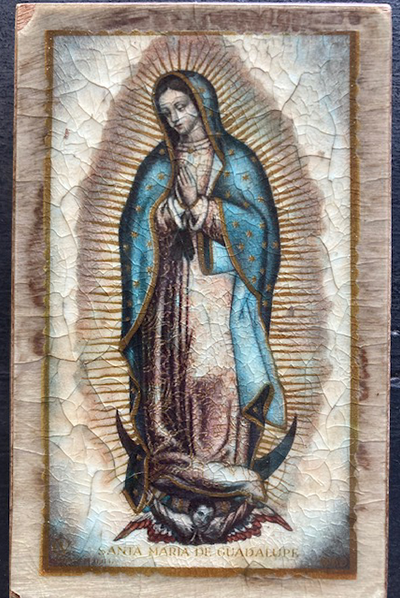
Mary of Guadalupe
For many decades this icon has been near our kitchen sinks. Our Lady of Guadalupe is named the Queen of Heaven and Earth. She was the mother of Jesus, who was born to be the last sacrificial blood offering, and thereby initiate a new dispensation: you are already forgiven and your work is to love one another.
Mary appeared to Juan Diego on Tepeyac Hill in December of 1531. She is a holy figure in the faith of many in the Central Americas. These are the most common offerings to Our Lady of Guadalupe.
Here are the most common offerings according to GoogleAI. These offerings are often placed at a home altar or altar in a church, which may include a statue or image of Our Lady, flowers, and candles.
1. Flowers (Specifically Roses)
- Red Roses: These are the most traditional, signifying love and mimicking the flowers found on the tilma.
- Floral Arrangements: Fresh bouquets are placed at her shrines, in churches, and on home altars.
- “Digital” Roses: Many sites allow pilgrims to “send a rose” or a bouquet to be placed at the shrine in Mexico City or local parishes.
2. Prayers and Spiritual Devotions
- The Rosary: Offering a “spiritual bouquet” by praying the rosary is considered one of the best ways to honor her.
- Las Mañanitas: A traditional song, essentially a “happy birthday” hymn, sung to her at midnight or early morning on her feast day (Dec 12).
- Mass Attendance: Attending Mass, especially on December 12.
- Novenas: A nine-day series of prayers.
3. Acts of Charity
- Serving the Poor: Because Mary appeared as a mother to the “little ones,” providing for the poor, forgotten, or elderly is a direct way to honor her.
- Donations to Pregnancy Centers: Offering items for babies (diapers, clothes) to crisis pregnancy centers, as she is the Patroness of the Unborn.
4. Physical Offerings and Symbolism
- Candles: Placed on home altars to signify faith and prayer.
- Food Offerings: It is common to share food with the community after services.
- Tamales: Steamed corn dough.
- Champurrado/Atole: A thick, warm chocolate-based drink.
- Buñuelos: Fried dough with sugar and cinnamon.
- Musical Offerings: Mariachi bands often perform at churches and in processions.
- Ex-votos (Retablos): Small paintings or items given in thanksgiving for a miracle or favor received.
We have quite a span of centuries between the temples of Malta beginning around 3200 BCE and circling our moon in 2026. To the tapestry add gold threads for the corn. In our century we are exploring how this energy manifests in each of us, calling us to make offerings of time, talent and dollars to the earth and each other.
Honoring My Goddesses of the Great Mother Conference
The field of poppies at the top of this blog was for us the Gate In and the Gate Out of the Great Mother Conference founded by Robert Bly. I want to weave into this blog’s tapestry both Bly, a fierce chaotic male presence, and the goddesses who matched his energy for many years. First is Gioia Timpanelli, the Dean of American Storytelling, who told the fairy tales we were exploring. Women were invited to co-lead, most notably Marian Woodman and Caroline Casey. Ruth Bly, “consort of the king”, sponsored formal ritual and dreamwork. Required afternoon workshops were led by Rita Shumaker (art) and muti-disciplined Ann Igoe (body movement).
“Movement is the basic unit. All is movement. The swirling atoms that make up everything are held together by movement. Movement when consistent creates a rhythm. The rhythm of the movement makes the combination that forms the creation. It determines the shape of things and reveals the phenomena of our known world. In art, movement is refined into gestures. From gesture comes symbol, word, and image.”
– Ann Igoe
The conference theme was chosen by Robert Bly, seldom mentioned directly but existing as a threaded energy. The conference’s underlying structure was a non-hierarchical feminine one: two rotating committees composed from community conference attendees each serving for three years. That structure prevailed when Robert died, and the Great Mother Conference lives on. This year the dates are May 20-27 at Camp Manitou in Oakland, Maine, and the theme is A Raft through the Sorrows: Longing, Belonging, Wonder and Chaos. For the Great Mother Conference multicolored threads can be woven on our loom, one for each of the thousands of attendees and hundred plus teachers. Threads swirling from the words of poetry and story form images that dissolve and then form again in a new shape.
Who would you name as a Queen of Heaven in your life? And what offering have you made to thank her for her gift to you?
Think of your comments as offerings to the theme so all may share the fruit of your reflection. Or send it to me by email. I do not know by name the hundreds of people reading this blog. Designer Desirae of Three Track Mind removes the bots regularly. You must be referring the blog to others; I thank you for that as I hope my offerings are of use to you and to them.
To the energy of the Queen of Heaven
I give thanks for the vision and practices
of a worldwide tapestry continuously woven
by those offering committed service to love.
References
Dominique Susani : books and pictures available by googling his name, and Energetic Geometry Classes here.
Poem stanza by Kohenet Batya Diamond at Cakes for the Queen of Heaven
Recipe 1: Palace Cake from the City of Ur (c. 2000 BCE, reconstructed)Sourced from Cathy Kaufman, “Cooking in Ancient Civilizations” (Greenwood Press, 2006), as published by AntiquityNOW. The original Ur record lists only butter, cheese, dates, and raisins — the flour, eggs, and milk are a scholarly reconstruction of what the bakers would have known to add.
Rita Shumaker Artist Profile and Teacher of the Arts: Rita Shumaker

Lola,
Brilliant! Love how you “weave” (pun intended) these threads together. We are all part of a giant tapestry. Celebrating you and your messages. – Lara