

In our planet’s cycle of seasons in the north we enter Lughnasa, harvest time. In this blog I’m tying together Lugh the Skillful god of harvest, a folk wisdom, and the difference between determinism and free will as a life choice. May my planting and weeding of ideas be skillful enough you harvest the critical point!
The saying “God Willing and the Creek Don’t Rise” is spoken in our family, though we say it much less often than our elders did. It’s my experience that folk wisdoms anchor profound truths still useful in our era. Depending on the belief system of the speaker I think this phrase conveys two profoundly different worldviews. Which world view predominates directly influences what the future will be.
The phrase is rooted in North American folk wisdom, originating in the rural areas of Appalachia. The phrase implies that to leave where you are involves crossing a local creek that has no bridge. My executive assistant Claude AI informed me that one other explanation comes from Benjamin Hawkins, a politician and Indian agent in the late 18th century, and suggests the phrase refers to the Creek Native American tribe rather than waterways—God Willing and the Creek Don’t Rise, Native Heritage Project.
What Folk Wisdom is Referred to/Anchored/Intended?
The person speaking may mean that all events, including whether the creek rises, are predetermined by divine will. The creek rising would be a specific divine intervention—God choosing to block your path through natural means. This view sees the natural obstacle as part of God’s sovereign plan. This is a Deterministic View.
In the Free Will View God created a world with natural laws (creeks rise when it rains heavily) and grants us free will to make choices within that created order. When saying the “creek don’t rise,” the speaker recognizes that natural forces operate according to their own patterns, not as direct divine interventions. The creek rising isn’t God intervening—it’s simply how the physical world works.
In the Free Will view if natural forces require you to adapt or change course it’s not because God is blocking your choice but because you’re living within the complex and sometimes challenging reality God created with its inherent patterns and laws. This view transforms the phrase from a statement about divine micromanagement to one about accepting both human agency and living with limitations. The “God willing” is an acknowledgment of human limitation rather than divine predetermination.
So what?
A lot of our lives depend on whether we frame what happens as direct divine action or as the natural consequence of living in a created world with its own rhythms and rules.
Deterministic Framework – Action Choices
Response to Setbacks: Obstacles are interpreted as divine messages or tests. The person might abandon plans more readily, seeing barriers as signs they’re not meant to proceed.
Planning Approach: Since everything is predetermined, planning becomes either futile (“what will be will be”) or a form of faithful obedience (“When God intervenes, I obey”). Behaviors follow beliefs and this framework can lead to:
- Acceptance of obstacles: When the “creek rises,” it’s viewed as God’s will to be accepted rather than overcome
- Passive acceptance: Less aggressive preparation since outcomes are fixed
- Faithful diligence: Planning and labor are part of doing one’s predetermined role
- Prayer-focused decision making: Extensive seeking of divine guidance before major choices
Risk Management: Lower investment in contingency planning since divine will needs to be obeyed. Alternative routes, backup plans, different solutions may seem to be a lack of faith.
Free Will Framework – Action Choices
Response to Setbacks: Natural obstacles are problems to solve rather than divine messages. The person might build bridges, find alternate routes, or wait for better conditions while maintaining their original goals.
Planning Approach: Robust preparation is a responsibility since outcomes depend partly on human choices:
- Proactive contingency planning: Multiple backup plans and alternative routes
- Environmental awareness: Careful attention to weather patterns, seasonal flooding, road conditions
- Resource preparation: Stockpiling supplies, maintaining emergency funds, developing survival skills
- Adaptive flexibility: Willingness to modify plans based on changing conditions
Risk Management: Heavy investment in preparation, insurance, and alternative strategies. The person takes responsibility for foreseeable challenges.
Key Behavioral Differences
- Preparation intensity: Free will believers typically prepare more extensively
- Persistence through obstacles: Free will believers more likely to find workarounds
- Prayer vs. action balance: Deterministic believers may pray more, plan less; free will believers balance both
- Responsibility for outcomes: Free will believers feel more personal accountability for results
My parents as elders lived in a forest fire probability zone and the area by the carport door is where their small legal file cabinet and picture folders lived, ready to be loaded into the car at a moment’s notice. My father would say “Come hell or high water, I….” His phrase aligned with the Free Will meaning.
End Time Applications
We are living in very difficult times as climate changes what is happening around the world. Deterministic versus Free Will viewpoints differ about the best way to live in these times.
Those of my family who have a Deterministic view of God have a strong belief that these are the end times. They watch for Jesus to come and save the holy believers. The changes in the weather are signs of the end times. The task is to accept this and watch for “the coming of the Lord.” They have no intention of doing anything that would prevent this Second Coming.
Those of my family who hold a Free Will viewpoint teach we are stewards of our blue-green planet home and we must do everything we can to stop it from turning into a fiery hell. They believe we are responsible for restoring the planet to a natural, balanced state. And they know that means changing the way we live our lives to be independent of oil. They want to fund restoration of habitat instead of increasing military budgets.
How to begin a meaningful conversation? How to attempt a Middle Ground?
Middle Ground
While working with these thoughts I observed my own premises around situations in my life. I operate largely from the free will point of view. However, sometimes when making a decision I feel a sense of despair, and it’s often because I am applying a deterministic view—“There is nothing I can do about this situation” or asking a question like “Why is this happening to me? It’s so hard.” But if during a difficult time, as a free agent, I ask “What lesson am I learning?”, I move to problem-solving and action.
When talking these ideas over with author Nancy King, who lives, teaches, and writes about overcoming vast obstacles in life, she offered this middle ground.
I’ve long felt uneasy at making flat statements about the future, …. so I frequently do it by making a statement about the present instead, as, “I aim to be ready by Thursday”; “I hear they’re getting in after dark”; “hope to see you tomorrow!”
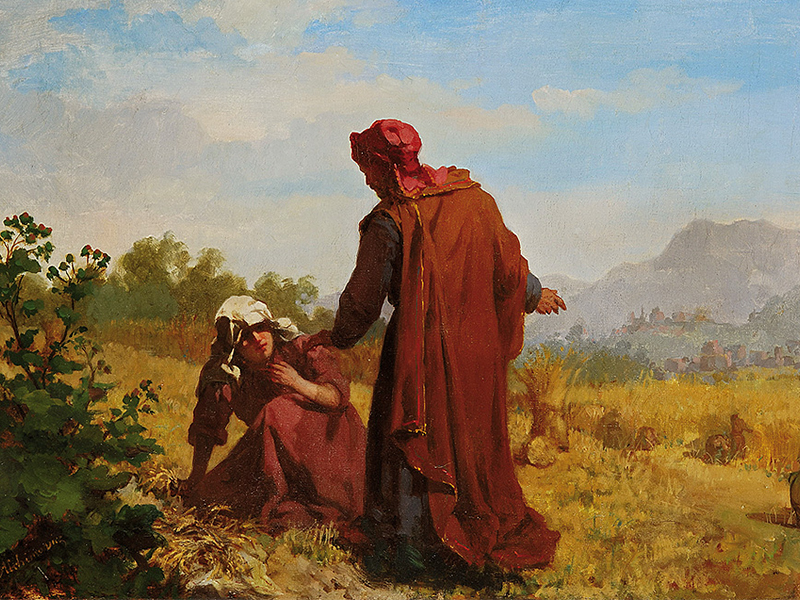
Ruth and Boaz rom the blog Lughnasadah: A Place of Grace, A Margin of Mercy.
Lughnasa: Harvesting Reality
Lughnasa is the season of “Harvest.” What happens at Harvest carries profound implications for how we understand divine providence, human agency, and the relationship between effort and outcome. In the image above Ruth is harvesting in Boaz’ fields because her mother-in-law has a plan of action to change their lives. Ruth is with her mother-in-law in a foreign land because she made a choice: “Where you go I too will go.”
Harvest in Deterministic Framework
Divine Sovereignty Over Outcomes: In this view, the harvest is ultimately predetermined by God’s will. The farmer plants and tends, but God determines whether the crops flourish or fail. Extensive drought caused by abnormal temperatures is divine intervention.
Human Role as Instrumental: The farmer becomes God’s instrument – required to plant and cultivate, but the actual yield is divinely determined. “You reap what you sow” becomes “You reap what God wills you to reap.”
Acceptance of Results: Poor harvests are God’s will to be accepted, not agricultural failures to be solved. Weather, pests, and crop diseases are divine tools, not natural challenges to overcome. The farmer’s role is to be faithfully present for whatever God has predetermined.
Harvest in Free Will Framework
Co-creation with Natural Laws: Here, harvest becomes a partnership between human effort and the natural world God created. Extensive drought is caused by Global Warming and action needs to be taken to correct course.
Genuine Consequences: “You reap what you sow” carries real weight. Good farming practices tend to produce better harvests, while poor techniques lead to crop failure. The connection between effort and outcome is meaningful.
Problem-Solving Responsibility: Drought, pests, and poor soil become challenges to address through better irrigation, crop rotation, pest management, or soil improvement rather than divine tests to endure.
Free Will Results: While the farmer can influence the harvest through skill and effort, natural forces (flooding creeks) operate according to their own patterns and might disrupt even the best-laid plans. These farmers take responsibility for what they can control while acknowledging what they cannot.
The Divine-Human Partnership in Lughnasa
Lugh, like Apollo, represented the sun and light and was an all-wise and all-seeing deity. As Apollo was associated with music Lugh is associated with craftmanship. Lughnasa is a celebration of Lugh’s triumph over the spirits of the Otherworld who had tried to keep the harvest for themselves., Lughnasa is a time to give thanks to the spirits and deities for the beginning of the harvest season, and to propitiate them with offerings and prayers not to harm the still-ripening crops.
Deterministic Framework and Lughnasa: In this view, Lugh’s divine will determines the harvest outcome. Human agricultural work becomes a form of worship and obedience, while the festival serves as acknowledgment that all abundance flows from divine decision. The “creek rising” would be another manifestation of divine will, potentially testing faith or redirecting human plans according to divine purpose.
Free Will Framework and Lughnasa: Lugh’s attributes of illumination, clarity, and inspiration suggest he provides the conditions and knowledge for successful harvest but humans must still apply skill and effort. The festival becomes a celebration of successful cooperation between divine gifts (sun, rain, soil fertility) and human craftsmanship. God works through human skill and creativity rather than overriding it.
Lughnasa marks the beginning of the noticeable descent of the Sun into the darkness of winter. The festival celebrates not just the harvest itself, but the successful navigation of the complex relationship between divine power, human skill, and natural forces.
Let me sing a song of understanding difference,
Difference that begins at the first thought, the premise,
And opposes my own.
I open my heart to comprehension released from judgment.


Thanks for expressing this polarity (determinizism vs free-will). I think a “true believer” in Determinism may take some issue with how you’re defining it, but I find the whole Blog very instructive. And, I have to ponder my own Point of View. I “think” I’m a Free-Will sort of thinker, but, what about when it comes to my garden? I plant as thoughtfully as I can, and pay attention to what I hear Rabbits, Chipmunks, Voles and Squirrels won’t eat. BUT, when I see parts of my garden desimated, I sigh and say “Everyone has to eat” and let it go. Now, I don’t replant the same things, you understand; I grow some things in pots on the deck vs in the ground. But even then, the chipmunks may hop up and take some bites from this height too. I even have evidence of a Groundchuck rising up and eating right out of a large pot of flowers. So, I guess I’m a bit of both – I do what I can, but if it doesn’t work perfectly, I am comforted to assume that “Nature [God] takes its course”.
I’m so happy you shared your reflections, Susan! I wonder if non-humans also have forms of determinism and free will – in the cocoon the caterpillar dissolves into a predetermined moth or butterfly but when hatched it explores and responds in different ways to its environment. Determinism may create a five generation migration but moving to where the nurturing plants are moving…some room there for a little free-will choice? When the environment changes … evolve or go extinct. I’m wondering if evolution is a blend of determinism and freewill.
We garden according to my husband’s grandmother’s free-will application to a determined fate: some plants for the rabbits and some for us. She taught us to pick 1/3 of the wild chokecherries, leave 1/3 for a neighbor who might pick these bushes, and 1/3 for the bears.
Lola, what a thoughtful and wise reflection on Lugnasa! Thank you: it was a pleasure to read. I am certainly cause/effect oriented but find the stewardship model quaint when our health is so inextricably tied to our ecosystem. We lack the power granted stewards, and can only function as one piece (albeit a powerful piece) of a complex system. We used to know our place and purpose in that system but sadly like cancer cells we no longer function for the good of that which sustains us and will perish as a result. Religion seems to have missed the opportunity to refresh our memory and guide us back to living within instead of living above.
Well, depressing perhaps but you’ve inspired me to think about this and our likely extinction. Blessed be, dear Lola, and reap a satisfying harvest. With love and respect, barb
I appreciate your honest response to this blog, Barb. The planet is suffering. Your phrase “living within rather than living above” describes one major cause. Greed is another for those in the Midas process of turning into gold. But I am placing my bet on those of us who choose stewardship, from the window gardener to the multiple volunteer organizations committed to doing what they can. I just read an article about the Arkansas river that rises in Colorado, and travels a very long and dirty way; it has champions (individuals, corporations, cities) for its health working on almost every mile of its wandering and succeeding in reclamation. Everywhere more and more people engage to do “something” for a beneficent future. (reference: https://coloradosun.com/2025/09/07/reshaping-the-arkansas-river-into-a-colorado-success-after-a-century-of-abuse/ )
I learned at an early age that I was responsible for everything I said and did. I also learned that many people refuse to acknowledge what they say and do, preferring to blame and judge. By taking responsibility for what we say and do, we have the possibility of growing and developing in deep and meaningful ways. Saying it’s “God’s will” avoids responsibility. Changing habits and pattern is is not easy but healthy growth is impossible without taking responsibility for our words and actions.
I appreciate your comments which add a bottom line to the determinism/free will: regardless of which platform of thought one stands on, do I take responsibility for my actions and outcomes. We can all say “Oops, my fault” followed by “let’s fix this”. Here’s to celebrating that moment of growth, and the development afterwards.
Thank you, Nancy, for accepting your responsibilities! They have been and are many, and you are committed to deep and meaningful ways of exploring.