

It’s Epiphany, the turning point in the Nativity story where Joseph and Mary change their lives and prepare to take the baby Jesus to Egypt. The word Epiphany is from the ancient Greek ἐπιφάνεια, epiphanea, meaning “manifestation, striking appearance” (The Magi). It can also mean “sudden or striking realization” (We need to take the baby to Egypt and out of political danger). The three become refugees.
Going on a Pilgrimage
I just returned from a pilgrimage in Türkiye and Greece titled “In the Footsteps of St. Paul.” I experienced an Epiphany around my own life. This blog is more overtly personal as I share my own reasons for going on the pilgrimage and what came of it. I hope you will find my pilgrimage useful to you in these times.
I journeyed along Paul’s Footsteps with thirty intelligent, caring, “come let us reason together” people, largely Colorado Episcopalians. I knew two of the pilgrims personally but we had not seen each other in years.
Both countries are new to me, Türkiye completely (except for ancient Troy and Alexander the Great). The Greece I know is from Homer’s oral tradition, the Iliad and the Odyssey. I write about and teach the ancient gods/goddesses stories. We would go to Delphi, the holy site of the truth telling oracle, and to Athens, a root of democracy. The rest of St. Paul’s Footsteps would be new places.
Two Other Pilgrimages
The only other organized pilgrimage I’ve been part of was to Ireland. It was a private tour, with a dozen people—a fourth of whom I knew very well, and we traveled in a van. We went elsewhere but centered at the shamanic training center in Dunderry, Ireland. I’ve written a few blogs based on what I learned on this Irish pilgrimage.
And my M.A. in Medieval English thesis was “Free Will in Chaucer’s Canterbury Tales,” which is a compendium of stories told by pilgrims of all classes and crafts to one another on their way to Canterbury Cathedral.
Like Chaucer’s pilgrims we stayed in “Inns” along the way. Ours were primarily small, well-organized hotels flavored by each location and the local people responsible for tending guests. This included fabulous food, which featured the region’s meats and vegetables. I ate enough variety of custards to gain weight though not much because always local honey was a primary dessert source, not sugar. Regardless of the meal, I would sit down to any table, and become part of a long and delightful conversation on a wide range of subjects.
Like Chaucer’s pilgrims, each of us had individual reasons for going on the St. Paul’s Footsteps pilgrimage.
And What About St. Paul?
I hesitated about going because St. Paul seems to me to be a person who thrives on being at the edge of dangerous situations. Some of his statements about women are very problematic. However, our tour leaders were experts on St. Paul (and archeology), and they promised new information and, perhaps, a different St. Paul.
He didn’t write all the letters tradition says he did in the Christian New Testament. The letters that are his are often very personal, written to specific people about specific situations. We would visit the cities where these people lived, stand in marketplaces where he stood and preached.
One of the first things we learned was the extent to which St. Paul and his teachings have been co-opted. Over time chosen sections of his words are no longer in context and certain messages to specific individuals generalized to apply to whole groups of people (especially women). As with Jesus, Paul’s words have been and are interpreted to satisfy the political needs of a dominant group at their point in history.
My Pilgrimage Focus
Just before leaving on the pilgrimage I had this dream:
I am climbing a wet cliff of reddish soil that keeps sliding me back down. It is raining. I finally manage to struggle to the top. Two tall, slim, muscled, brown skinned, interested and kind police are there. They ask “Who are you?” I know my name but while climbing and sliding have lost my identification. I tell them to call my sons, but I don’t know the phone numbers (this would be true). They have to imprison me until this can be sorted out.
It was quite a disturbing dream asking “How do you prove you are who you are?” There were obvious current cultural overtones to this question.
I did a Celtic tarot reading to help sort my thoughts about the dream. The reading was complicated and confusing, and seemed to be about a little girl. In the morning I pulled a single card as a checkpoint summary. It was the eight of swords. For those interested I use the Rider Waite deck, which you can see in full here.
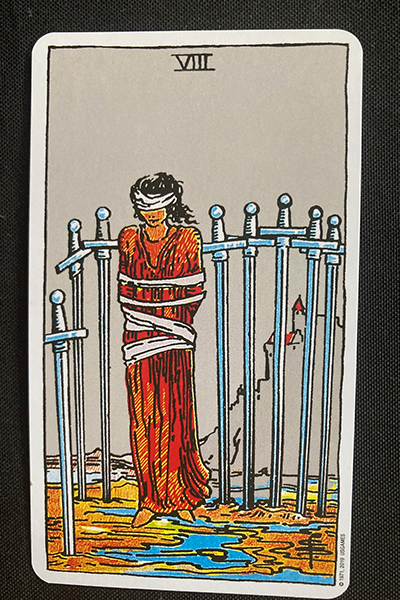
What was the blindfold? What were the bindings that were making me feel like “a little girl” who knew who she was but had no proof of identity? And how do I unbind myself? How would the pilgrimage help me answer these questions?
Four Epiphany Realizations
We flew there and back in two Turkish Air planes (14 hours of luxury from Colorado to Istanbul – over 6,000 miles – and then back again). This is a long flight, and while heading to Istanbul I thought about the dream and the tarot’s “little girl.”
Epiphany #1 Removing the blindfold—a “little girl”
When I was a very small child my mother was ill and my father, mother and I were focused on helping her be well. I never knew whether today would be an ill or a well day; this is the same situation now with my husband.
We were visiting our son at the remote farm in Costa Rica we co-own when Covid quarantined us in paradise. My husband lost his ability to travel. Parallels to when I was a little girl:
- Remote means the rest of the world is outside your house and “yard.”
- 20 years ago electricity came to this remote valley where we bought property. Families have lived here for generations. We are very welcomed, but I am like a child watching a functioning adult world.
- Every one around us speaks Spanish; our Spanish is like a child’s. Language you don’t understand flows around you. Things have to be explained to you.
- An “adult” who knows what to do drives you over rough roads to town once in a while for everything you need from radishes to residency applications.
- I am not “helpless” but I am dependent on others for almost everything.
Unlike when I was a little girl, here we have local nurses who help with my husband’s care for nine hours of the day and are available at night. I am responsible for the remaining hours but can call them if I need help. Together we are barely able to lift him from bed to wheelchair. Our backs hurt. I could not afford nurses in the United States.
To realize I am often in the position of a small child wondering what is going on removes a blindfold. Modern communication vehicles like Zoom allow me to be in adult level interactions with the rest of the world. On the Footsteps of St. Paul tour I am an adult with other adults, speaking English, sharing our daily adventures, reflecting and discussing, laughing. The interactions are healing.
Epiphany #2: Shrug, “Such is Life”
Our modern buses seat 30 people very comfortably; they have no bathrooms so our guides built that limitation into the tour (yea, frequent stops).
Our Turkish guide was … amazing. A tall, fit, muscular man, his long career had been in construction, eventually of large projects. His last huge project was so full of graft at every level he retired. He had just the right touches of cynicism and love of justice. Microphone in hand as we traveled the road, he educated us on the land, history, politics, people. Some comments were followed by a left shoulder shrug and a grin, and him saying “So is life.” Then we would reach the site and be turned loose to explore it. He walked with us, always available to answer questions or tell a story. Our Greek guide followed a similar pattern.
Back on the farm now when I have a Spanglish conversation or go to town, I live with the healing thought “Such is Life.” I’m practicing the shrug. In Spanish I say “Así es la vida”. We laugh together.
Epiphany #3: LIft it Up, Put it Down
A Daily Schedule Comment (edited): “Today we go to Izmir / Ephesus / The House of Virgin Mary / Kusadasi. We drive to Istanbul Airport to fly to Izmir. Upon arrival, we continue to Ephesus. The Apostle Paul visited in 53 A.D., and, according to tradition, in order to protect the Mother of the Church from persecution the Apostle John brought Mary here where she is believed to have spent the last days of her life.”
I love Ephesus. It is the city of the Amazons and a major worship center for centuries of the Virgin Goddess Artemis. In my Sacred Geometry classes I’ve been taught how to search a site for the natural configuration that underlies it, giving it a specific energy. Outside the House of Mary I borrow another pilgrim’s cross because I have forgotten my pendulum. I stand in the center of the house, and the cross in my hand spins on its chain horizontal to the ground, pulling at my fingertips. The rising vortex is so large the whole house is inside it. I feel it has a light purple color—not lavender. My energy, my spirit rises—no wonder this place moves the heart of so many pilgrims!
Leaving Mary’s House I return the cross. There are tourist shops, and I am drawn to one where I buy a necklace I can wear to douse upcoming sites. I like it because it is also the Irish triple spiral, reminding me of the energy of New Grange and the Hill of the Calliach from the Irish pilgrimage. Everyone likes it, many want one, saying “It’s perfect for my niece for Christmas,” or other comment. People search but it appears to be one of a kind as no one finds another anywhere.
Our ongoing formal group discussion that night explores the idea of “Lift it Up, Put it Down.” When you feel anxious or alone or fearful, pray. Lift it up, you at the center of a prayer that the Source of all Energy hears. Then you Put It Down. It’s being taken care of—don’t nag. Concentrate on living your life fully, what is happening in this very moment. “Be Here Now.” I have no difficulty “lifting it up;” I am learning the healing, enriching practice of “Putting it Down.” I lift up the difficulties around the caretaking of my husband. And I put it down. I’ve asked. I will receive.

Epiphany #4: You know to Whom you Belong
Schedule Comment: “We transfer to the Istanbul Airport for our morning flight to Thessaloniki. (Greece) Meet our guide and driver to drive to the ancient route of Apostle Paul to Amphipolis (Acts 17:1). We journey to ancient Philippi, which was named after the father of Alexander the Great. This busy Roman colony boasted a great library and theater. In Philippi, Paul preached, established the first church in Europe. He wrote the Philippians one of his epistles while imprisoned in Rome (Acts 16:11-40; Philippians).
In Acts 16:11-15 we learn about Lydia, and how she and then her whole household become converts.
We enter the place where Lydia meets Paul, walking on a rectangular black rock next to one that is worn down by thousands of feet stepping on it—similar to the steps in Canterbury Cathedral. We are where Lydia and other women are gathered by the river when Paul comes and preaches to them. Lydia and her household are baptized in this river in this place. Lydia is a very successful business woman, a seller of cloth dyed purple worn by wealthy and powerful people.
There is a small amphitheater where the river flows through a narrow cement channel. We renew our baptismal vows which include questions that remind us of how to live our lives. The response to each question is “I will, with God’s help.” Particularly meaningful to me are these questions:
Will you continue in the Apostles’ teaching and fellowship….? (that would include St. Paul)
Will you seek and serve Christ in all persons, loving your neighbor as yourself?
Will you strive for justice and peace among all people, and respect the dignity of every human being?
Then, only two at a time, many pairs forming randomly, we go down and kneel, one on either side of the river channel. Across from me a young woman, whose name I can’t remember in that moment, her face full of joy and light, dips her hand in the river, and marks a cross with the very cold water on my forehead, saying, “In the Name of the Father, and of the Son, and of the Holy Spirit.” The water runs down my cheeks, cold, baptizing.
I dip my hand in the water which then drips from my hand as I mark the cross on her forehead, saying, “Remember to whom it is that you belong.”
I feel these words come alive, warm, comforting, present inside of me. I know to whom I belong. I belong to Love, which both holds the galaxies and is incarnate in us all.
Coming Home
This trip was my first vacation in five years. I love to travel and I went to new places, and shared my time with people who have “an inquiring and discerning heart, the courage to will and to persevere, a spirit to know and to love you, and the gift of joy and wonder in all your works.”
I came home rested and healed. The very next week my son and his wife located a (very inexpensive!) Hoyer Lift on the coast. Looking something like a giraffe on a platform, the patient lift painlessly lifts and swings my husband between wheelchair and bed. I didn’t know such a wonder existed.
“Lift it up. Put it down.” Shrug. “So is life.”
Comments:
As always your comments are deeply appreciated, and make the void I send the blog into become real. You can email me and/or use the comment box below to include other readers.



Lola,
I laughed out loud when I read, “I am practicing the shrug.” I can see you doing it perfectly.
From Eileen Connolly’s book “Tarot, A New Handbook for the Apprentice” she states that the Eight of Swords tarot card key is “Unable to make any decision, you feel very restricted. Have experienced hurt or anxiety.” The sword suit key is struggle and animosity. With your home situation being restrictive in many ways as a caregiver, I am thrilled to read that you took this trip to such a meaningful place. Thank you for posting your experiences in such a personalized way. Inspiring! Best of all was reading, “I belong to Love, which both holds the galaxies and is incarnate in us all.” Amen. Truly!
Lara, Thank you for imagining me practicing my “shrug” and then laughing! Hurrah. And, like many times when I’ve chosen to learn a new habit, the opportunities to apply it multiply. I think choosing to not be grumpy, depressed, sarcastic, or otherwise reactive opens me, perhaps all of us, to loving and healing action.